
MAP Master Amino Acid Pattern® (MAP™)
What is MAP™?
MAP™ is a patented combination of essential amino acids in a highly purified, free, crystalline form. (Essential amino acids are nutrients that are indispensable for human life because they cannot be synthesized within the human body. After oral ingestion, MAP™ is rapidly utilized. MAP™ does not require the aid of peptidases (digestive enzymes) and therefore is absorbed within 23 minutes through the first 100 cm of functional small intestine. MAP™ does not provide any fecal residue. MAP™ is a Natural Health Product (NPN-80009710) that can be obtained without prescription. (MAP™ does not contain any non-medicinal ingredients.) Canadian Patent No. 2 054 268.
What is MAP™ used for?
MAP™ is used to support body protein synthesis (BPS).
How does MAP™ support body protein synthesis (BPS)?
The results of comparative, double-blind, triple- and quintuple-crossover Net Nitrogen Utilization (NNU) clinical studies have shown that the subjects, while taking MAP™ as a source of amino acids, achieved a body’s 99% NNU. This means that 99% of MAP's constituent amino acids followed the anabolic (build-up) pathway, thus acting as precursor of body protein synthesis (BPS). The studies have also shown that 1% of MAP™’s constituent amino acids followed the catabolic (breakdown) pathway, thus releasing only 1% of nitrogen catabolites (waste) and energy (1 g MAP™ releases 0.04 kcal).
To illustrate: After amino acids are absorbed they can follow either the anabolic (build-up) pathway or the catabolic (breakdown) pathway (Fig. I).
Figure I. The Anabolic and Catabolic Pathways

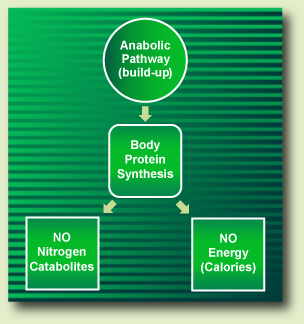
When amino acids follow the anabolic (build-up) pathway, they act as precursors (“building blocks”) for body protein synthesis (BPS), thus becoming the body's constituent proteins. Throughout the anabolic pathway, amino acids do not release any nitrogen catabolites (waste) or energy (Fig. II).
Figure II. The Anabolic Pathway
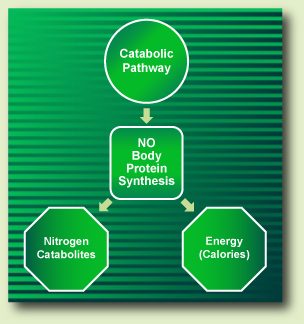
On the other hand, when amino acids follow the catabolic (breakdown) pathway, they act only as a source of energy and not as precursors of body protein synthesis (BPS). Throughout the catabolic pathway, amino acids do release nitrogen catabolites (waste) and energy (Fig. III).
Figure III. The Catabolic Pathway
Are there any cautions and warnings?
Do not use if pregnant or breastfeeding. Consult a health care practitioner prior to use if following a low-protein diet. Caution phenylketonurics: this product contains phenylalanine. No adverse reactions have been reported.
What is the dosage?
As a source of amino acids to support body protein synthesis, take 5 to 10 tablets per day preferably with food or as directed by a health care practitioner. Tablets can be pulverized and mixed with food or beverage. If taking more than 10 tablets per day, increase the dosage gradually. In order to optimize the results, do not take more than 10 tablets of MAP™ within a two-hour period. (If gastrointestinal disorders are present, pulverize tablets to allow for better absorption.) Consult a health care practitioner for use beyond four weeks.
What are the medicinal ingredients?
MAP™ is supplied in tablets of 1,000 mg for oral administration. Each tablet contains: L-Leucine 189.6 mg, L-Lysine HCl 172.4 mg, L-Valine 160 mg, L-Isoleucine 143.2 mg, L-Phenylalanine 124.5 mg, L-Threonine 107.3 mg, L-Methionine 67.5 mg, L-Tryptophan 35.5 mg. MAP™ contains no non-medicinal ingredients. MAP™ is available in bottles of 120 tablets. MAP™ is also known as SON Formula. (Store in a cool, dry place.)